Part VIII · Beyond Earth — Consciousness as the condition of a multiplanetary species
The question is who arrives.
“Whether humanity becomes a species of more than one world is not, in the end, an engineering question. The engineering is hard and will be solved. The question is who arrives.”
Two reasons to reach for another world, and two different destinations.
Flight: “This world is becoming difficult, so let us secure another. It is the oldest human motive dressed in titanium.”
Understanding: “A mind which knows only one world does not yet know what a world is.” Closer to the Sanskrit jijnasa, the desire to know, “held as a discipline rather than a hunger.”
“A settlement founded as an escape will reproduce the conditions it escaped.”
“The established facts first, because the ethics only become interesting once the difficulty is honest.”
ATMOSPHERE
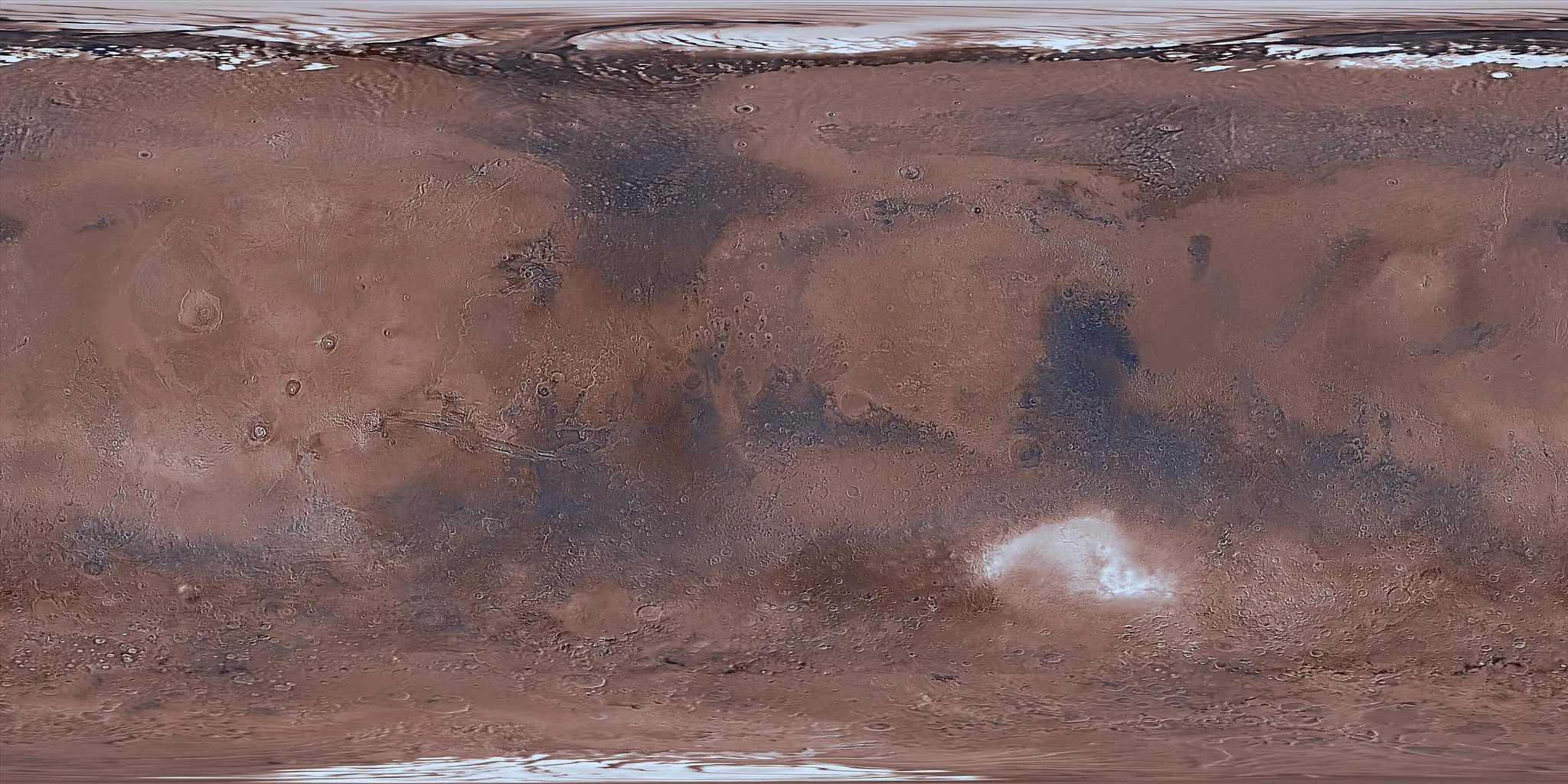
About one per cent of Earth’s surface pressure, mostly carbon dioxide. Unbreathable, and too thin to shield or hold warmth.
RADIATION
No global magnetic field. Long exposure is hazardous; shielding means living under regolith or rock.
TEMPERATURE & SOIL
Far below freezing. Perchlorates in the regolith, toxic to humans and hostile to most crops.
DISTANCE
Several to over twenty minutes of radio delay each way. “No rescue is available on human timescales.”
“Mars is a place where every proposition in this book stops being a proposition and becomes a physical constraint.”
Nothing can be externalised
“In a sealed habitat there is no downstream and no elsewhere. Every waste stream returns to the people who produced it.”
Enough becomes a number
“A horizon on wanting is not a spiritual attainment there; it is printed on the wall.”
Truth becomes structural
“A concealed error in a life-support system kills… Satya is the operating requirement of a closed habitat.”
“Three days away rather than eight months. Close enough that mistakes are survivable — which is the definition of a place to learn.”
“A failure there is a lesson rather than a funeral.” The harder curriculum is not technical:
- How does a small group govern a shared, metered commons without either tyranny or collapse?
- How is dissent handled when everyone depends on the same twelve systems?
- What happens to grievance in a place no one can leave?
“The Moon is a laboratory for terrestrial restraint.”
“A Mars settlement is, by construction, the most captive arrangement ever designed.”
“Whoever writes the rules before departure writes them permanently… That is an argument for doing the philosophical work now, while it is still cheap, and while the people it will govern can still participate in it.”
The space treaty regime is “a decent foundation and an inadequate structure.”
Dharma here “requires that the founders of any settlement accept limits on their own authority before they are beyond the reach of anyone able to impose them.”
The qualifying condition is not propulsion. It is character.
“If a sealed world makes restraint, honesty and located responsibility into survival requirements, then the qualifying condition for a multiplanetary species is not propulsion. It is character — and character can be specified.”
Nothing is outside
“Not a belief — a habit of accounting, learned before departure because it cannot be learned after.”
Report the error now
“The capacity to report your own error immediately, while it is still embarrassing.”
Tapas, made ordinary
“The ability to want something available and not take it, repeatedly, without supervision and without resentment.”
Forgiveness as maintenance
“Grievance carried in a closed system compounds until it becomes structural. Forgiveness stops being a virtue and becomes maintenance.”
Alone with one’s mind
“The capacity to be alone with one’s own mind, without input, for long periods, without deterioration. The most predictable failure mode of long-duration spaceflight is psychological.”
Nishkama karma
“Every founding act on another world is performed for people the actor will never meet. Nishkama karma… is the only motivation that survives it.”
“The disciplines that would let a hundred people survive on Mars are the disciplines that would let eight billion survive here.”
Chapter 43 · “Space does not require a new ethics. It removes the slack that let us postpone the one we had.”
“A civilisation is ready to inhabit a second world when it has demonstrated, on the first one, that it can inhabit a limit without being forced to.”
“By that measure we are not ready. By that measure, becoming ready is the same project as repairing the Earth — and neither has to wait for the other.”
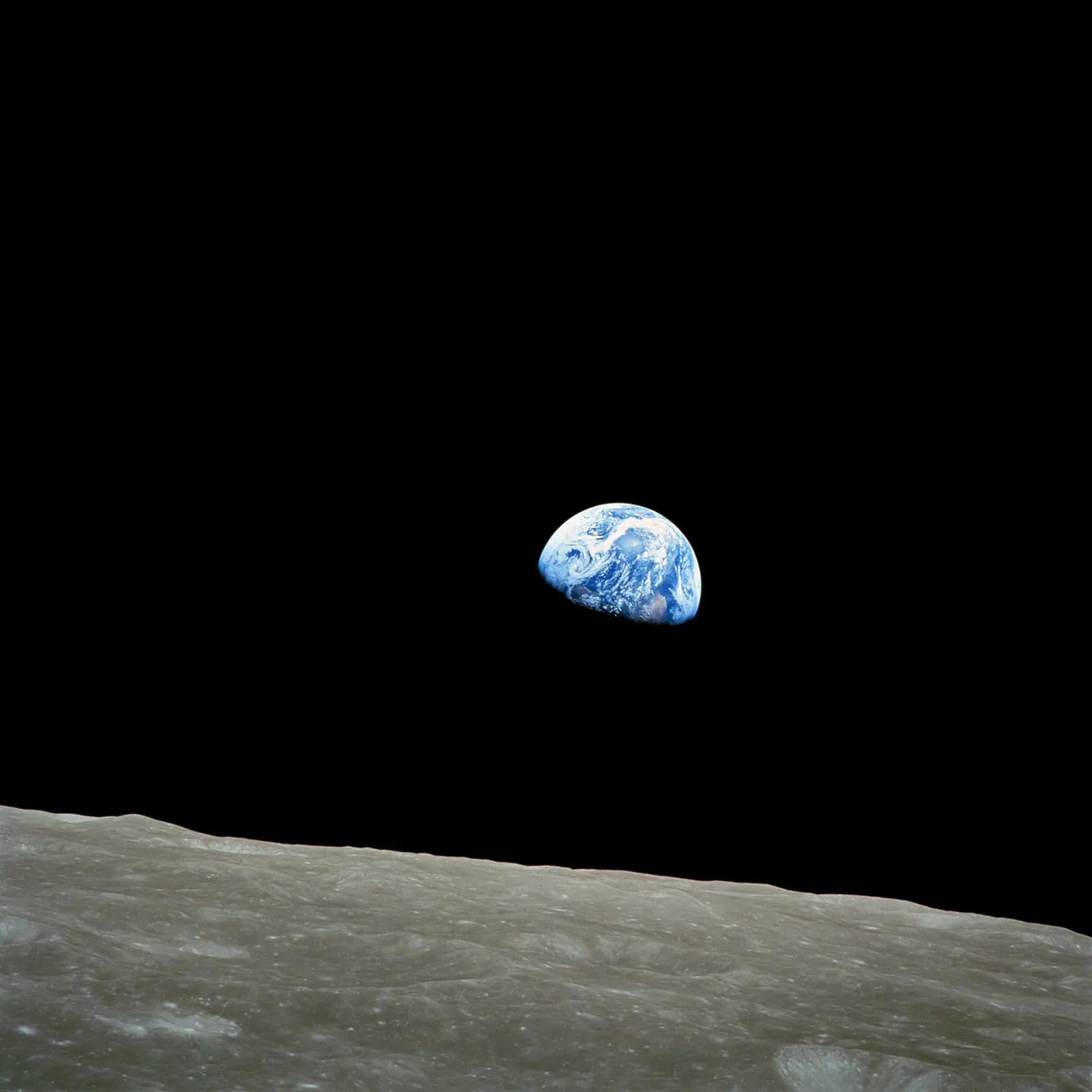
“Space has so far served consciousness best not by giving us somewhere else to stand, but by showing us where we already stand.”
Chapter 39 · Photo: Earthrise, Apollo 8, 24 December 1968 (NASA, public domain)Mars is not a backup.
“A civilisation that cannot maintain a planet already equipped with breathable air, liquid water, topsoil, a magnetic field and four billion years of biological infrastructure will not maintain one lacking all five.”
“Curiosity is a legitimate reason. So is the scientific value of a second data point on planetary evolution and possibly on life. Neither of these requires framing the venture as escape.”
“Whatever we become elsewhere, we will bring with us… Which makes what we become here the whole of the work.”
Humility, built in.
The author’s notes on planetary science carried a standing instruction, kept in his words: “do not apply until verified by those qualified to verify it.”
The discipline he proposes for any new world: “observe before acting; verify before applying; do not proceed on conviction where verification is available… understand the system, coordinate with rather than override its conditions, act at the right time, and hold intention to account.”
This page is offered as a human-values and resilience contribution, not as engineering, mission design or clinical guidance. Any practical use with crews would need qualified space-psychology and mission experts.
Ask the question before the launch.
For NASA, ISRO, SpaceX and every space programme. It searches his Beyond Earth chapters, the Mars essay and his thought-sheets on Mars and asteroids. Human values, not engineering.
- His caution comes with it: do not apply until verified by those qualified to verify it
- Chapter and page on every answer from the book
- Off-topic questions fall back to all his writings, clearly labelled
What this framework can offer a space programme.
A shared vocabulary for crew character
Six specified traits, from closed-loop ethics to interiority, for ethics panels, crew-culture discussions and selection conversations led by qualified experts.
From Chapter 43Settlement governance, before departure
Questions to work through while “it is still cheap”: who writes the rules, how authority is limited, how dissent and grievance are handled.
From Chapters 41–42Space as a mirror for Earth
Closed-loop systems and governance patterns learned on the Moon apply to arid cities and to any community holding a commons.
From Chapter 41The SatyaYuga Framework white paper
Part VIII, “Beyond Earth,” together with the Earth, practice and AI sections, with sources and the author’s verification note.
“We will not become a species of many worlds by escaping this one. We will become it by learning, here, to live inside a limit.”