Satyayuga Geeta
Read the book
A distraction-free reading room. Choose a chapter; your place and reading mode are remembered on this device.
Opening

Part One
The Turning Point
A diagnosis before a prescription. What has actually changed in the human situation — and why the change is not first of all economic or technical.
- 01 The Question We Cannot Ignore Can humanity transform its consciousness before the consequences of its current way of living transform the planet beyond recognition? Free 2 min
- 02 Kaliyuga Is a Condition, Not a Date In the traditional understanding, time moves through four ages. In this book, those ages are read as descriptions of collective attention. Free 3 min
- 03 The Invisible Crisis Before the forests and the aquifers, something else was quietly depleted: the human capacity for undivided attention. Free 2 min
- 04 When Capability Outruns Conscience Every civilisation is a wager that its wisdom will keep pace with its power. Ours is the first to place that wager… Free 2 min
- 05 The Ecological Warning This chapter deals in evidence, not interpretation. The figures below are reported measurements, attributed to the bodies that produced them. Free 2 min
- 06 The Cost of Disconnection The ecological and the psychological crisis are not two crises. They are one crisis, observed from two distances. Free 2 min

Part Two
The Inner Ecology
Desire, ego, karma and dharma — treated not as religious furniture but as the working parts of human motivation, and therefore of civilisational behaviour.
- 07 Desire Without a Horizon A desire with a boundary is satisfied. A desire without one is a mechanism, and mechanisms do not stop. Preview 2 min
- 08 Ego: The Illusion of Separation Ego, in this book, does not mean confidence or self-respect. It means the belief that I am fundamentally separate — from other… Preview 2 min
- 09 Karma Begins as Intention The word has been flattened into a folk theory of cosmic punishment. Its more interesting meaning is closer to: action, understood together… Preview 2 min
- 10 Dharma as Responsibility Not law. Not religion. Not custom. Dharma is the answer to a harder question: what does this situation, and my place in… Preview 2 min
- 11 The Mahabharata of the Self One way to read the epic — an old and widely held way — is as a psychological map. Kurukshetra becomes any… Preview 2 min
- 12 Action Without Destructive Attachment The Gita’s most quoted teaching is also its most misread. It does not counsel indifference to outcomes. It counsels the separation of… Preview 2 min

Part Three
Satya
What SatyaYuga means in this book: not a date on a cosmic calendar, but a condition of integrity that can begin in a single life and spread.
- 13 What SatyaYuga Means Here In the traditional accounts it is the first and finest of the four ages. In this book it is a definition, and… Preview 2 min
- 14 The Four Pillars Four disciplines, each drawn from established Indian ethical vocabulary, each narrowed here into something a person can actually practise on a Tuesday. Preview 2 min
- 15 The Truth State A term of my own, used throughout this book. It names a condition rather than an achievement, and it can be lost… Preview 2 min
- 16 The Discipline of Listening On intuition — what it is reasonable to say about it, what is not, and why the practice is worth keeping either… Preview 2 min
- 17 Can an Age Begin in One Person? The most contestable claim in this book, stated plainly so it can be argued with. Preview 2 min

Part Four
Kalki Darshan
On the tenth avatar as a symbol of correction rather than punishment — and on the difference between transformation driven by fear and transformation driven by responsibility.
- 18 What Kalki Represents The tradition first, stated accurately. Then the reading this book offers, marked clearly as a reading. Preview 2 min
- 19 The Sword That Cuts Falsehood Any philosophy that speaks of destruction owes its reader an exact account of what is to be destroyed. Here is mine: patterns,… Preview 2 min
- 20 Between Fear and Transformation Prophecy and catastrophism produce the same emotion and the same result. Neither produces change that lasts. Preview 2 min
- 21 Kalki Through a Contemporary Lens If correction is a pattern rather than an event, it should be visible in the record. It is — and the record… Preview 2 min
- 22 The Possibility of Renewal Renewal is not the same as recovery. It does not restore what was; it builds what the failure made thinkable. Preview 2 min

Part Five
The Earth
Where the inner argument becomes physical. The chain that runs from unbounded wanting to a degraded biosphere — and the chain that runs the other way.
- 23 We Are Not Visitors Here The classical scheme of five elements is not chemistry. But as a way of noticing that a body is made of a… Preview 2 min
- 24 The Chain of Consequence The link between a state of mind and a degraded river is not mystical. It runs through a chain of entirely ordinary… Preview 2 min
- 25 What the Instruments Record Five systems, and the fact that makes them one problem: they are coupled. Pressure on any one propagates through the others. Preview 3 min
- 26 The Ethical Dimension of Ecology Why environmentalism framed only as risk management keeps losing, and what a different framing makes available. Preview 2 min
- 27 From Extraction to Regeneration Sustainability aims to stop making things worse. Regeneration aims to leave a system in better condition than you found it. The gap… Preview 2 min

Part Six
Technology and Consciousness
Neither worship nor refusal. A serious look at what we have built, what it is doing to attention, and the conditions under which it could serve something other than appetite.
- 28 The Mirror We Built Machine learning systems are trained on the record of what humans have written and done. Whatever else they are, they are a… Preview 2 min
- 29 The Attention Economy A market in which the product is a human capacity, the customer is not the user, and the currency is the only… Preview 2 min
- 30 Can Intelligence Serve Consciousness? The question is not whether machines will think. It is whether the people directing them will. Preview 2 min
- 31 Cosmos, Mars and the Ethics of Expansion A chapter of category E — speculation, marked as such. The question it asks is not whether we can leave, but who… Preview 3 min

Part Seven
The New Human and the Next Civilisation
From diagnosis to design. What education, work, law, food, energy and cities would look like if the previous six parts were taken seriously.
- 32 Six Shifts Not new virtues. Six changes of position, each of which a single person can make this year without permission from anyone. Preview 2 min
- 33 Education as Remembering If information is now free and judgement is scarce, then an education optimised for recall is training children for a competition that… Preview 2 min
- 34 An Economy of Contribution Markets are among the most effective coordination instruments ever built. The problem is not the instrument. It is what we have asked… Preview 2 min
- 35 Law, Governance and the Long Term Our institutions were designed to protect against tyranny and to settle disputes between present parties. They were not designed to represent the… Preview 2 min
- 36 Cities, Food, Energy Three systems that convert philosophy into physical fact. In each, the technical answers are broadly known and the constraint is elsewhere. Preview 3 min
- 37 Youth, Science, Spirit Three constituencies this argument depends on, and what each is owed. Preview 2 min
- 38 Earth 2050: A Thought Experiment Category E, and deliberately so. Not a prediction, not a plan — a description of a plausible near future written to make… Preview 2 min

Part Eight
Beyond Earth
Whether humanity becomes a species of more than one world is not, in the end, an engineering question. The engineering is hard and will be solved. The question is who arrives.
- 39 Why We Look Up There are two reasons a civilisation reaches for another world, and they lead to entirely different destinations. Preview 2 min
- 40 What Mars Actually Demands The established facts first, because the ethics only become interesting once the difficulty is honest. Preview 2 min
- 41 The Moon as Apprenticeship Three days away rather than eight months. Close enough that mistakes are survivable — which is the definition of a place to… Preview 2 min
- 42 Who Goes, and Who Decides Every settlement in human history was shaped less by its destination than by who was permitted to found it, and on whose… Preview 2 min
- 43 The Consciousness Requirement If a sealed world makes restraint, honesty and located responsibility into survival requirements, then the qualifying condition for a multiplanetary species is… Preview 2 min

Part Nine
The Invitation
Twenty-one principles, a practical pathway at every scale from a single person to a society, and the one decision the book cannot make for you.
- 44 Twenty-One Principles for a SatyaYuga-Oriented Life Not slogans. Each principle has a definition, an application specific enough to do tomorrow, and a question that only you can answer. Free 1 min
- 45 The First Step Eight scales, one entry point each. Find the scale you actually operate at and start there — not at the largest one,… Preview 3 min
- 46 The Reader’s Choice There is one thing a book cannot do, and this is the page where it becomes obvious. Preview 2 min
Epilogue
8 of 48 chapters are free to read here, and every other chapter opens with a preview. The complete book holds them all.
Get the complete book (opens in a new tab)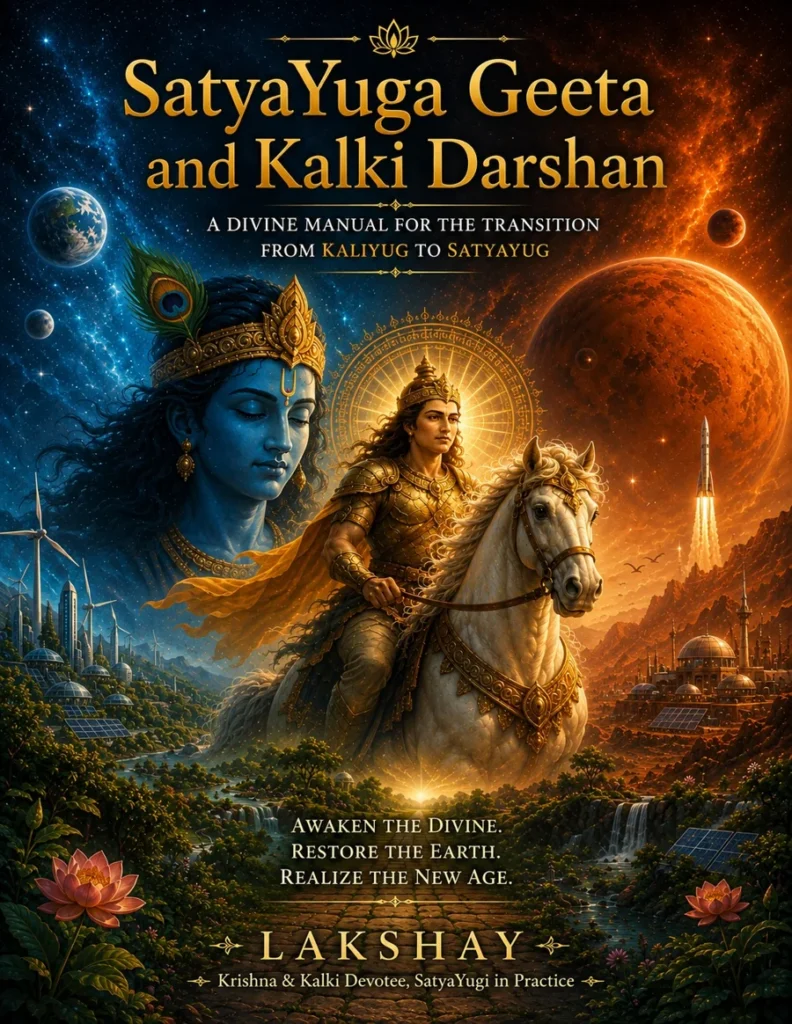
The book
SatyaYuga Geeta and Kalki Darshan
A Vision for Human Transformation, Ecological Restoration and a New Age of Consciousness
- Pages
- 130
- Chapters
- 46
- Principles
- 21
- Sutras
- 108
Can humanity transform its consciousness before the consequences of its way of living transform the planet beyond recognition? Nine parts and forty-six chapters — from the inner ecology of desire and ego to soil, screens, Mars and the next civilisation — with 21 working principles and 108 sutras.
-
 Part One
The Turning Point
6 chapters
Part One
The Turning Point
6 chapters
-
 Part Two
The Inner Ecology
6 chapters
Part Two
The Inner Ecology
6 chapters
-
 Part Three
Satya
5 chapters
Part Three
Satya
5 chapters
-
 Part Four
Kalki Darshan
5 chapters
Part Four
Kalki Darshan
5 chapters
-
 Part Five
The Earth
5 chapters
Part Five
The Earth
5 chapters
-
 Part Six
Technology and Consciousness
4 chapters
Part Six
Technology and Consciousness
4 chapters
-
 Part Seven
The New Human and the Next Civilisation
7 chapters
Part Seven
The New Human and the Next Civilisation
7 chapters
-
 Part Eight
Beyond Earth
5 chapters
Part Eight
Beyond Earth
5 chapters
-
 Part Nine
The Invitation
3 chapters
Part Nine
The Invitation
3 chapters