
About
A vision, a book, a journey
Kalki Darshan brings the teachings of Lord Krishna and the tradition of Kalki into conversation with the questions of our time.
What is Kalki Darshan?
A community for seekers, rooted in ancient wisdom
Kalki Darshan is a non-profit initiative committed to sharing spiritual experience through the teachings of Lord Krishna and Kalki. Its aim is to inspire spiritual growth, drawing on the insights of esteemed gurus and respected traditions.
It began with the vision of a single seeker: to create a community where people can explore spirituality through the teachings of revered mentors and the ancient wisdom of India — and to ask what that wisdom asks of us now.
01 — The Vision
The transformation begins with consciousness.
Darshan means seeing — the sacred act of beholding, and in Indian philosophy, a complete way of seeing reality. Kalki Darshan reads an ancient promise of renewal as an invitation to the present.
Before the world changes, perception changes. Before societies heal, the way we see ourselves, one another and the Earth must heal. Drawing on the teachings of Lord Krishna, the tradition of Kalki and the guidance of living teachers, it asks a simple question with vast consequences: what would a golden age require of each of us, today?
02 — What is Kalki Darshan
Six ways of seeing
Not a doctrine to memorise, but a way of seeing to practise. Kalki Darshan gathers its vision around six movements of awakening.
01

Consciousness
Every transformation begins as a change in awareness. The inner life is the first frontier.
02

Dharma
The order that sustains life — right action, responsibility and truthfulness in everyday conduct.
03

Human Transformation
From reaction to reflection, from fragmentation to wholeness: the patient work of becoming fully human.
04

Ecological Restoration
The Earth is not a resource but a relationship. Restoring it begins with restoring our reverence.
05

Universal Harmony
Beyond borders and creeds — the recognition of one life moving through all beings.
06

New Age of Consciousness
Satyayuga, the age of truth, held not as a prophecy to wait for but as a possibility to live toward.
03 — The Foundation
21 Principles
Twenty-one principles from the Satyayuga Geeta form the ethical and spiritual foundation of Kalki Darshan — a compass for conduct, thought and inner life.
-
Truthfulness is not mainly about avoiding lies; most people rarely lie outright. It is about the daily traffic of small distortions — the flattering version, the…
Read the principle Say the true thing -
The most common way an ordinary person spreads harm is by forwarding a claim they have not examined.
Read the principle Check before you repeat -
Decide in advance what enough looks like, in writing, for the things that matter — income, space, possessions, recognition.
Read the principle Keep a horizon on wanting -
Restraint is a capacity, and capacities are built by use. The content matters less than the regularity: a purchase declined, a reply not sent, a second helping refused…
Read the principle Withhold one thing daily -
Begin with speech, which is where most people do most of their damage, and extend outward: to the people who are easy to be careless with, to animals, to the systems…
Read the principle Widen the circle of non-harm -
Not meditation necessarily, and not requiring any belief: simply a defended period in which nothing arrives.
Read the principle Keep an interval with no input -
Most regretted actions were not wrong in execution but unexamined in motive. The interval between impulse and action is where a life is actually determined, and it can…
Read the principle Know the intention before the act -
Any framework that mainly identifies faults in others has been misused, and this one is unusually easy to misuse that way.
Read the principle Examine yourself before others -
Unattributed work is the most efficient corrective to ego available, because it removes the reward the ego was working for.
Read the principle Do work no one will attribute to you -
Not everything, not nothing. Given where you stand, what you can see and what power you hold — what is actually yours?
Read the principle Locate your responsibility precisely -
Care about outcomes; measure them; do not let them be the engine. An action powered by its reward degrades when the reward is delayed and collapses when it fails to…
Read the principle Act without needing the fruit -
An age of abundant beginnings produces very few completions, and completion is where almost all the learning is.
Read the principle Finish what you begin -
Food is the most frequent and most physical transaction between a person and the biosphere — several times a day, every day, for a lifetime.
Read the principle Eat with attention -
Abstract concern for the planet is unsustainable; specific responsibility for a patch of it is not. A balcony, a verge, a stretch of riverbank, a courtyard tree.
Read the principle Tend one piece of ground -
Traditionally, satsanga means keeping the company of the true — people, texts and settings that make honesty easier. The principle now extends to a feed.
Read the principle Choose your inputs like food -
Gratitude is the direct antagonist of a moving reference point: it is attention paid to what is already here.
Read the principle Practise gratitude concretely -
Promise less and deliver it. The reliability of a person is not a moral decoration; it is the material institutions and relationships are built from, and it is…
Read the principle Close the gap between word and deed -
The two failures are certainty that cannot revise and doubt that cannot commit. What is wanted is neither: convictions strong enough to act on and held loosely enough to…
Read the principle Hold opinions loosely, act firmly -
Forgiveness is not the excusing of harm and does not require reconciliation. It is the decision to stop spending present attention on a past injury.
Read the principle Forgive, to free your own attention -
Choose at least one undertaking whose completion you will not see: a forest, an institution, a body of work, a child’s formation, a repaired relationship between groups.
Read the principle Build for a horizon beyond your life -
Hope here is not optimism, which is a prediction, and not denial, which is a refusal.
Read the principle Keep hope as a discipline
Purpose
Our core values
Kalki Darshan exists to inspire spiritual growth — drawing on the insight of respected teachers and traditions — and to offer that inspiration with care.
Compassion
We believe in fostering compassion towards all beings, encouraging understanding and empathy in our spiritual journeys.
Integrity
Integrity is at our core: we strive to live our teachings authentically and encourage open, honest communication within the community.
Inclusivity
We welcome individuals from diverse backgrounds to join us in the pursuit of spiritual growth and enlightenment.

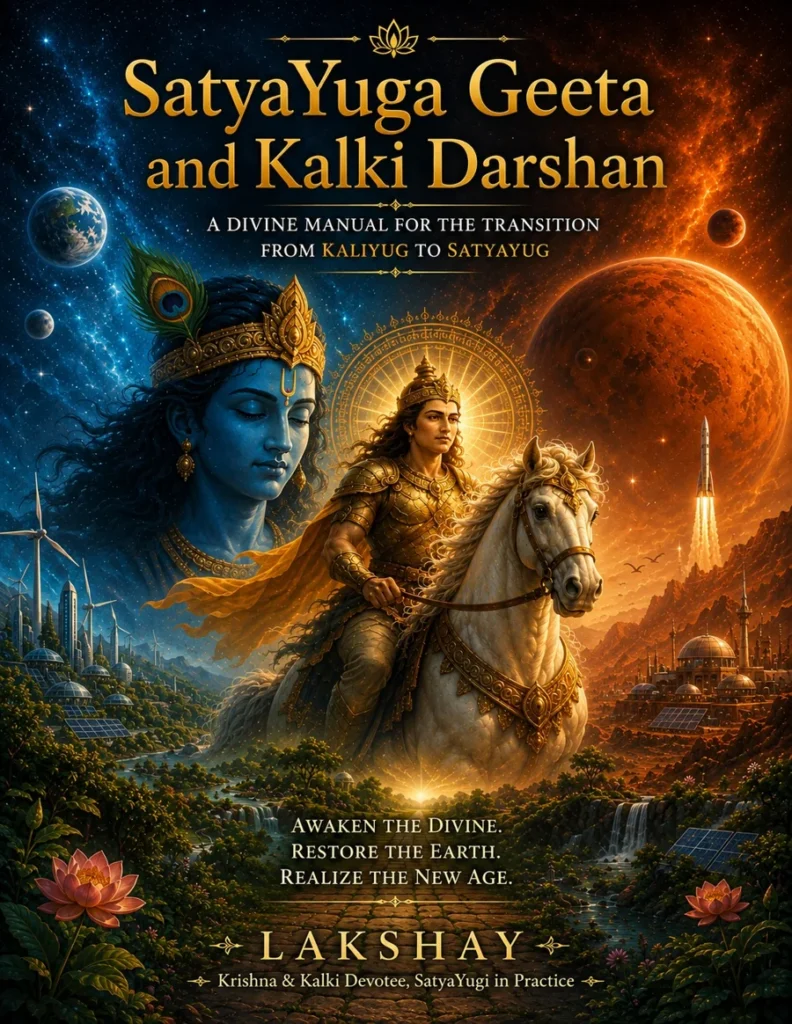
The book
SatyaYuga Geeta and Kalki Darshan
A Vision for Human Transformation, Ecological Restoration and a New Age of Consciousness
- Pages
- 130
- Chapters
- 46
- Principles
- 21
- Sutras
- 108
Can humanity transform its consciousness before the consequences of its way of living transform the planet beyond recognition? Nine parts and forty-six chapters — from the inner ecology of desire and ego to soil, screens, Mars and the next civilisation — with 21 working principles and 108 sutras.
-
 Part One
The Turning Point
6 chapters
Part One
The Turning Point
6 chapters
-
 Part Two
The Inner Ecology
6 chapters
Part Two
The Inner Ecology
6 chapters
-
 Part Three
Satya
5 chapters
Part Three
Satya
5 chapters
-
 Part Four
Kalki Darshan
5 chapters
Part Four
Kalki Darshan
5 chapters
-
 Part Five
The Earth
5 chapters
Part Five
The Earth
5 chapters
-
 Part Six
Technology and Consciousness
4 chapters
Part Six
Technology and Consciousness
4 chapters
-
 Part Seven
The New Human and the Next Civilisation
7 chapters
Part Seven
The New Human and the Next Civilisation
7 chapters
-
 Part Eight
Beyond Earth
5 chapters
Part Eight
Beyond Earth
5 chapters
-
 Part Nine
The Invitation
3 chapters
Part Nine
The Invitation
3 chapters
The Journey
How the vision took shape
- GuidanceThrough the grace of his spiritual gurus, Mr. Sunil Kaushik and Mr. Umesh Sharma, the author was guided onto the path of enlightenment and toward the presence and love of Lord Krishna.
- InspirationBharma Narayan Guru and Ohm Shanti illuminated the path and inspired the writing of the Satyayuga Geeta — a testament to eternal truths, written to revive the spirit of a golden age.
- The Kalki traditionSadguru Riteshwarji Maharaj deepened his understanding of the Kalki Avatar, the tenth avatar of Lord Vishnu in Hindu tradition.
- The bookThe Satyayuga Geeta and Kalki Darshan: more than 130 pages, 46 chapters, 21 Principles and 108 Sutras.
- The journey continuesThrough the Journal, the online reader, talks and gatherings as they are announced — and through everyone who takes up the questions for themselves.
Continue the path
Begin with the principles, wander through the sutras, or read the book from its first page.